

Minimalist Style | 3
I love having a minimal wardrobe and it definitely forces me to get creative, but sometimes I just want to wear something else. Something I haven't worn a thousand times over, and feels "new to me." Well, those are the moments it's nice to sneak into the husband's side of the closet and steal his clothes! Haha - am I alone in this?! Depending on what I steal, he either loves it or gets irritated, but I can't help it - his clothes are the comfiest!
In today's example, I'm showing you how I style a typical men's t-shirt three different ways. It's been a while since I've snuck this particular shirt of his (we used to fight over it, and I finally gave it back up to his keeping), but I just think men's t-shirts are the best for styling purposes.
Minimalist Style | 1
Minimalist Style | 2
Here are my easy outfits broken down:
1. Patterned pants, flats
2. Flowy skirt, necklace, heels
3. Jeans, belt, hat, flats
Boyfriend/husband/oversized tees are so easy and fun to style. You could also throw on a cardigan, shorts, and sandals. Or a maxi skirt, skinny belt, floppy hat, and sandals. So many amazing options out there, but below are just a few to get your wheels turning. Go "steal" that hubby's t-shirt!


Excuse my little photo bomber :) Hope you enjoyed these simple ideas!
Don't forget to follow me on social media to stay up to date and connected. Feel free to message or email me with any content requests, ideas, or collaborations!

Minimalism: Where Do I Start?
When people learn about our aspirations towards minimalism, the first thing they almost always ask is, "Okay. Where do I start? What should I throw out first?"
Though their heart is in the right place, the real heart of minimalism isn't actually about getting rid of things... or even things at all! Yes, it's about owning less, but that looks different to each of us. The answer their question of where to start, is more of a defining nature.
Where do you feel there is excess in your life?
Can you even recognize it?
Do you feel like you're always, always cleaning?
Are you forever picking things up in the house?
Is your work draining and causing you to have very little steam left for your family at the end of the day?
Do you feel burdened by financial issues or debt?
Are you barely getting by and feeling as though there's never enough money?
Are you constantly at various functions for your kids, work, community?
Do you fill your plate too full (literally and figuratively)?
Do you feel like you're constantly playing catch-up with your basic life to-dos?
Are you just spread too thin and can never seem to spend time on the things you truly enjoy?
The excess in your life could be tangible or not. It could be the excess of your mind's constant to-do list. It could be the excess from your job stresses. The looming bill you're having trouble paying. The many times a week you eat out because you don't have time to cook or grocery shop. On and on...
I talk to friends who just don't seem like they even have time to take a breath. They're tired. They're stressed. They're weary.
And don't get me wrong, sometimes that's just part of a season. "Busy" can be a short term thing. In fact, I'd say that right now, we're in one of those seasons. We have work, engagements we're committed to, trips to plan and go on, an endless to-do list, and appointments to make. Unfortunately none of these things can "give" and we have to just muddle through, but I know there will be slower seasons to come. However, I can tell you most assuredly, that having less home to deal with, and less stuff to clean or organize or use, makes even the busiest of seasons far less weary.
So to answer your question... where should you start?
Start practicing minimalism by...
1. Deciding where your excess lies.
Excess can look so different from one person to the next. Start by looking at the activities you do or things you own.
Working full-time? Raising kids? Kids in activities? Volunteering? Going to every social gathering you're invited to? Leading everything and anything you're asked to head-up? Taking on projects or tasks you can't really dedicate to? Working too much? Keeping a large house in order? Hosting all the time? The sight of your cluttered garage or closet is giving you anxiety? Don't think, just answer - what is pushing you over the edge?
It's essentially up to you, but just figuring out what it is that causes you to feel overdrawn will be the first freeing step of many. It doesn't have to be something big. It could be as small as feeling stressed every time you open your overstuffed pantry.
When we moved to Georgia, I was feeling disheartened by the workforce I had been in previously and I didn't want more of the same. So, I chose a riskier route, and because of my choice to work from home instead of pursuing a career in the corporate world, I've had the freedom to travel, create my own hours, host often, not have to drive in the insane traffic (saving me boatloads of time!), and spend lots of time with my husband. It wasn't the easier route by any means, but it removed the excess that burdened me, and instead gave me the opportunity to explore entrepreneurship.
2. Figure out how to pare down.
Think about these things, and I mean really think about them. Which of these things could you pare down in some way? Could you go to part-time work if the financials allowed it? Could some of the activities your kids are involved in be pared down to one activity per kid? Would downsizing your home or investing in a cleaning service take that off your plate? Could you ask others to host the next time there's a get-together? Could you take a weekend to re-organize and purge your kitchen - even just a few drawers or cabinets?
Break those seemingly big tasks into smaller ones. Get creative with solutions that work for you, but get out of your comfort zone.
If you can't seem to let things go, have a friend or relative help you put things in keep, donate, and toss piles. If you can't quit your job or go part-time, what can you let go of to create more time for yourself or your family? Can you hire a sitter every other week for a couple of hours so you can get dinner with your spouse? Can you split up the housework more evenly with your family so you can spend more time being together? Can you say no to the next volunteer opportunity until work slows down? Can you start ordering your groceries online and simply pick them up to save you the time? (This is a free service at a lot of places these days).
Now, this is just the start, friends. It doesn't have to be earth shattering, and you don't have to make it difficult or overthink it. Simply look over your current state, define what is important to you, figure out what's keeping you from those things, and remove or pare down those excesses over time. I'll get into other steps and tips to help you live simply and minimally in future posts, but for now, I hope you've got an idea of how to begin.
And if there is anything specifically regarding minimalism that you're curious about, drop me a comment, message me on Facebook, or contact me - I'd love to hear your questions!

Minimalist Style | 2
Have you guys been seeing this 'kimono' trend? I have been seeing it around the last couple of years, but was unsure of the point. I try to be more functional than stylish these days, so I kept thinking "Is it like a cloak? But it doesn't keep you warm..? Is it mostly for tall people? Or moms? Is it supposed to be fancy?" ... and then I tried one on. All those question blew out the window and I got hooked. So this is my first kimono and three simple ways to wear it - trust me, it probably won't be my last one.
On the topic of the functionality? I actually love it for summer. The summers here can be sweltering, and I love that the breathable material actually helps keep you cooler. The sun beating down on me doesn't feel nearly as hot, and somehow I've felt far less sweaty and gross when I'm donning it. It's also just really dang comfy while also feeling cute. I'd say kimonos are a win-win-win. Let me know what you think.
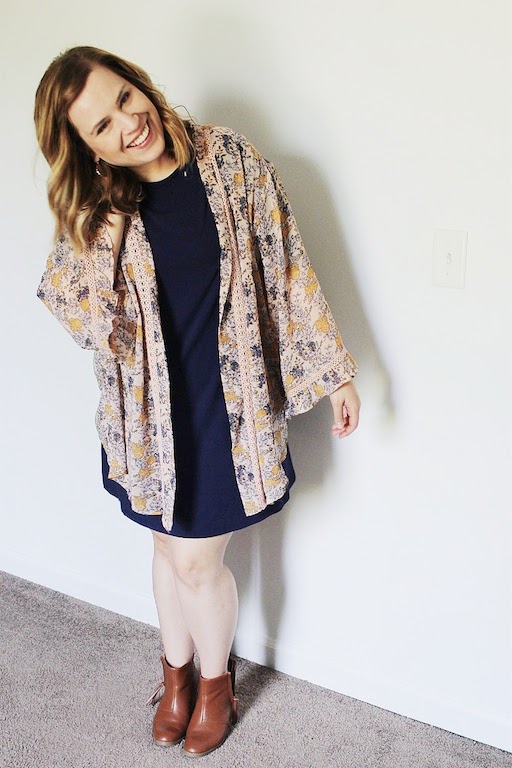
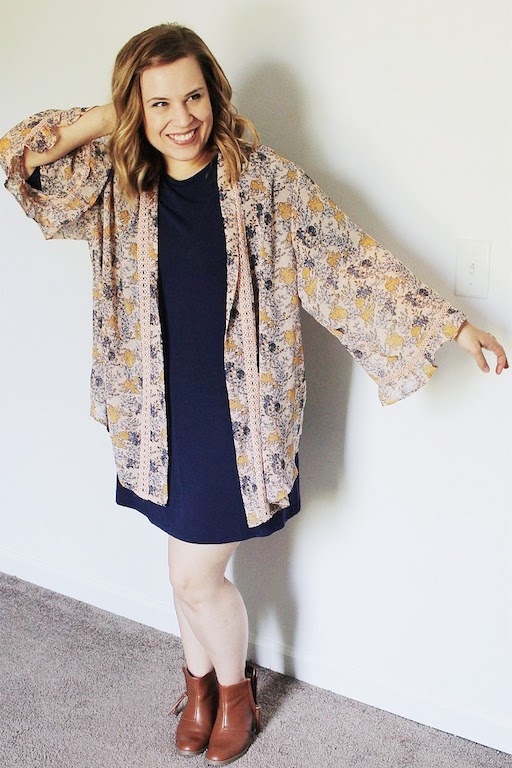
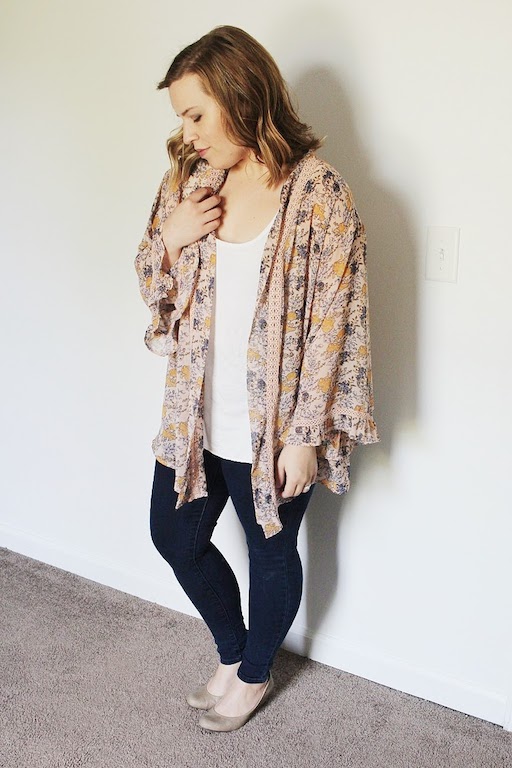
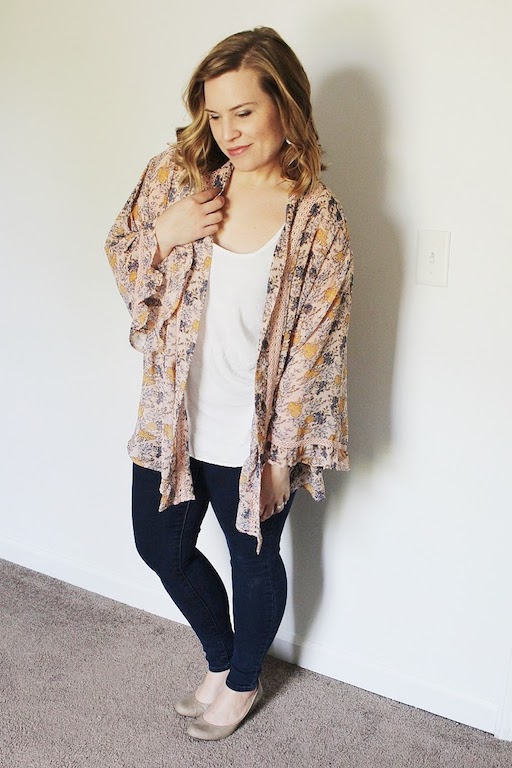
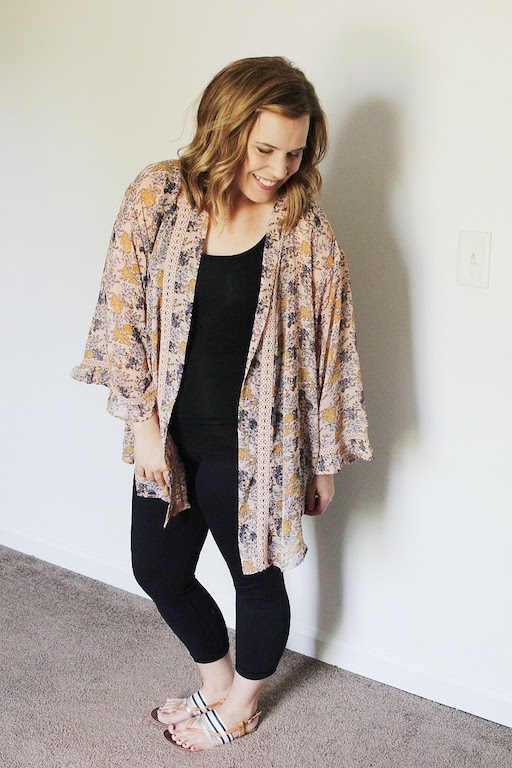
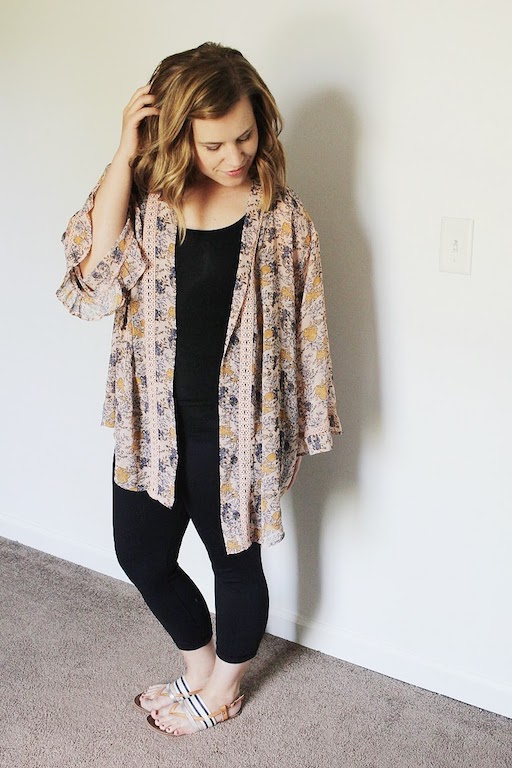
There you have it! Super simple ways to mix up the same item. Of course, these could be adjusted by switching out different types of shoes, or adding jewelry, or trying different hairstyles, but I figured I'd focus on the basic adjustments you can make with staple items you probably already own!
What do you think of the kimono trend? Would you give it a try, or are you waiting for it to pass?

DIY Moss Frame
Lately, Tom and I have been feeling a little restless. Now that most of our big projects are done, we're on a hunt for a new one.... or we're trying to decide if we should permanently work remote from an RV for a year while we travel the country (I'm kind of kidding about that one). Regardless of where this restlessness sprouted from, it's caused us to tap a little deeper into that creative part of our brains.
Admittedly, I am not usually one for DIY decor. I've done enough of it to know that about a month later, I'll find exactly what I just made at Target... and it looks better and is cheaper. It's like my personal curse. It happens every time!
But amidst this funny little season, we've been having some fun. Let's just say, I discovered the way of... THE HOT GLUE GUN. Best four bucks I ever spent. Lemme show you what's up:
On a recent excursion to Michael's with Tom, I started to meander through the fake flowers while he found a good frame to mount a recently acquired print from Goodwill. 'Twas in this time that a small lightbulb grew atop my head... and the moss-covered-frame was born.
Materials
- Frame (I used this one) $6
- Hot glue gun and glue sticks $8
- Bag of moss $10
Total: $24 (though there is plenty more moss and glue for another project)
Directions
See the photos below.
Basically, just glue chunks of moss around the frame and you're done! It was actually really fun, and I'm very happy with the results. I may hang it as-is, or add a very minimal print. We're hoping to create a bit of a gallery on either side of the TV and so far we've gathered a nice start. I snagged that lovely Monet print at Goodwill for $6 as well - thrifting is the way to go, my friends!
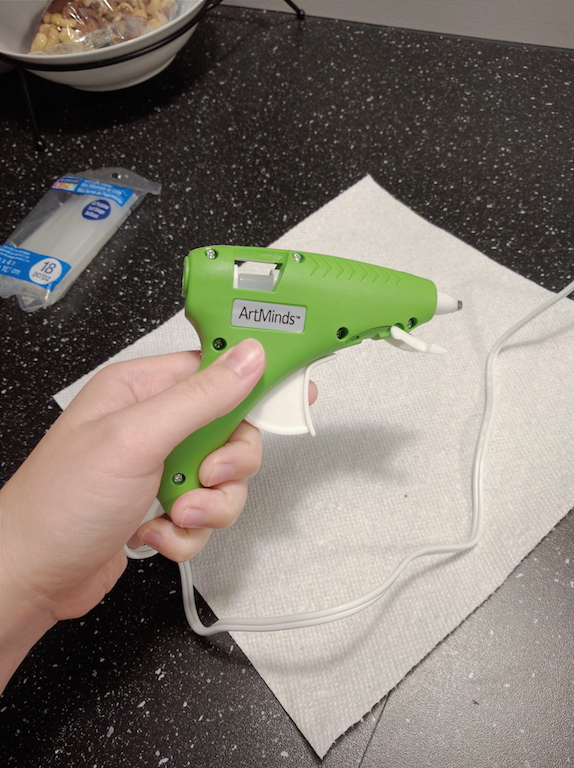
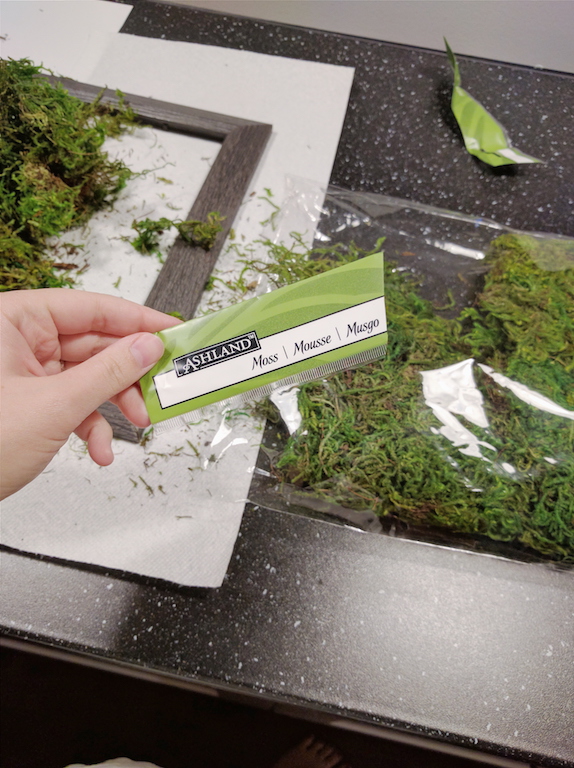
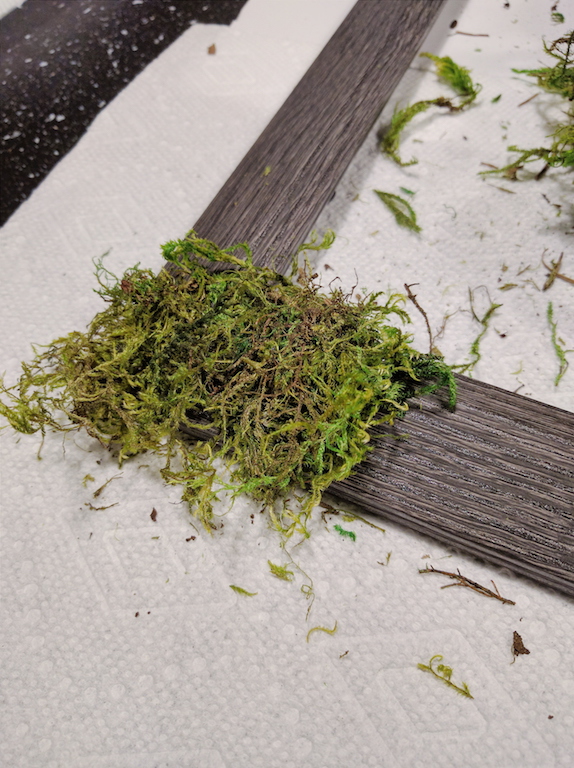
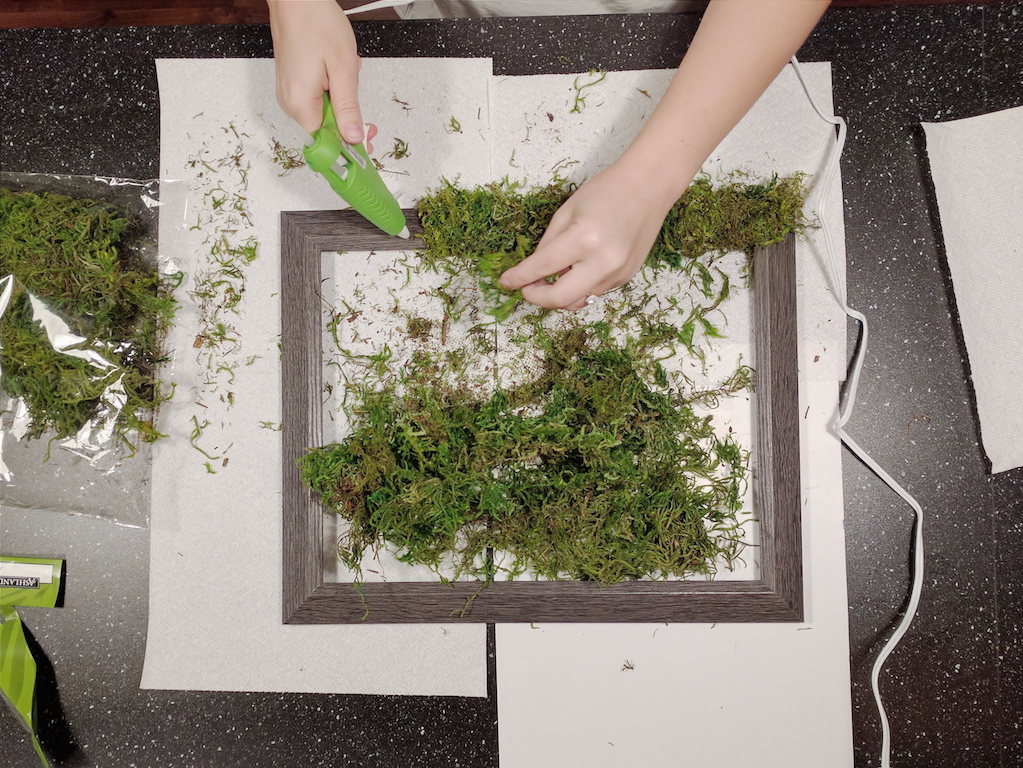
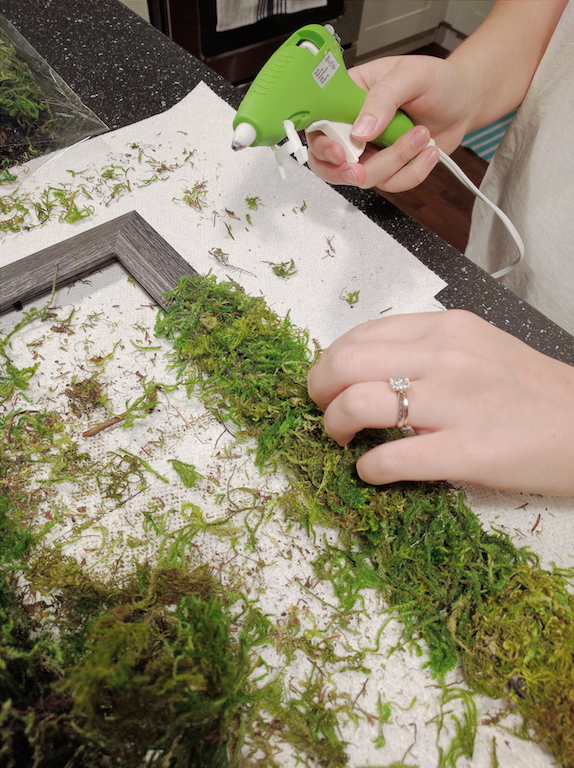
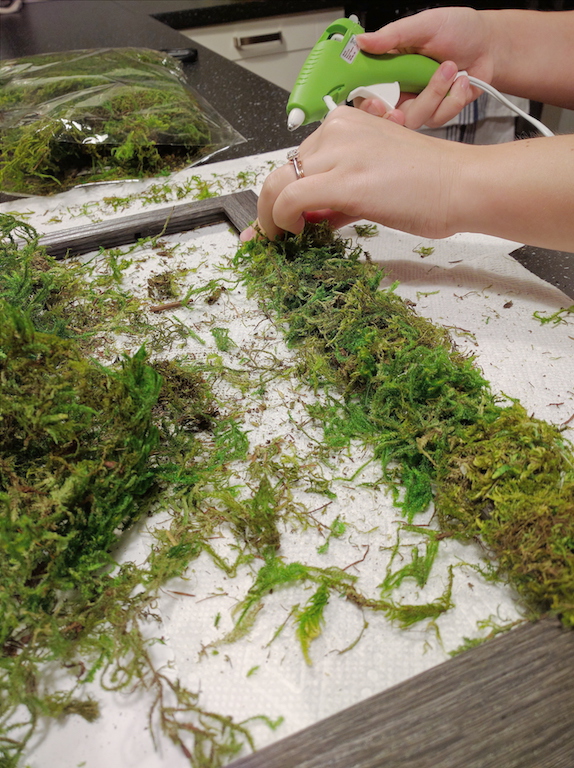
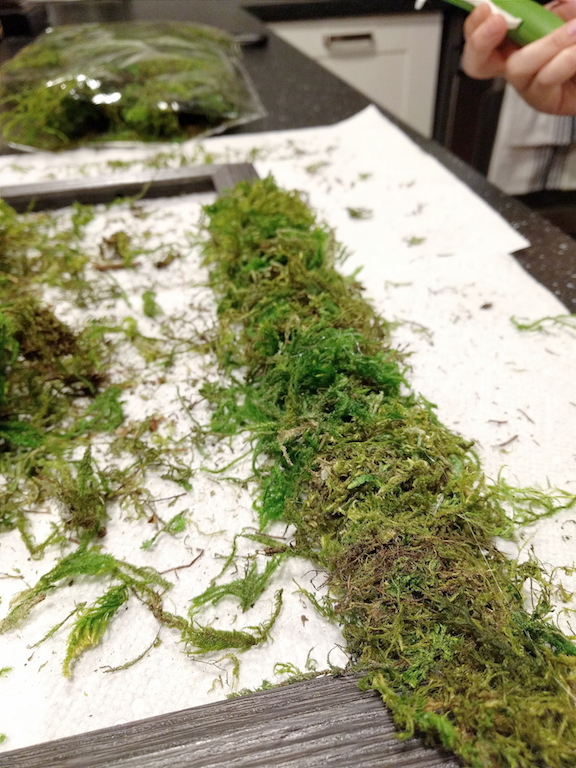
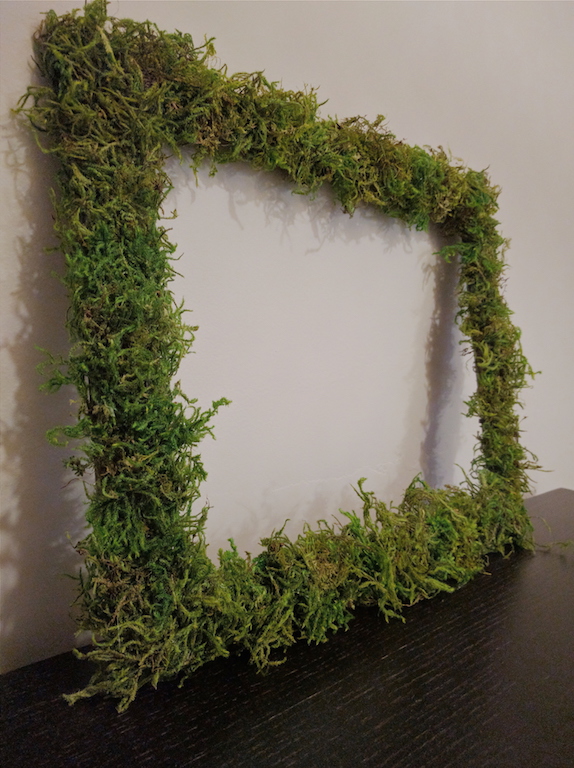
What do you think? For about twenty minutes and minimal effort, I'm not disappointed in the least! Time to moss up everything I own... get it "moss up" ...like, "mess up"..?

Shopping Habits Of A Minimalist
Have you ever felt possessed by your possessions? I'm sure anyone who has made a significant move knows the feeling. You know, the one where you start packing boxes and going through drawers and storage while exclaiming under your breath, "Where did this even come from? How do I have so much stuff and not realize it?"
We all do it.
But it's a habit that can be broken and free you of the possession of possessions. For some, it may mean changing the way in which they shop - the topic I'm covering today. And what's better, it can not only free you of material excess, but of the excess found in financial burdens and excess of the heart. Minimalism has, more than anything, given me freedom.
What draws me to minimalism is the mantra of putting the simple joys in life above the things we surround ourselves with. It puts an emphasis on experiences or travel (read this) and creating an organized, manageable life (read this) so that you can give experiences or loved ones more of your time. Our things won't follow us when we pass on, but our lively natures, stories, and memories will be there for others to cherish. That's not to say that our things don't sometimes offer sentimental joys or make our lives easier by owning them... just that we should be choosy and realistic as to what is necessary, beautiful, or valuable.
As someone who used to spend a lot of my free-time shopping, this was a hard habit to break. A dress, a purse, a pair of earrings, shoe sales, hair products, a new throw blanket, decor I had no place for, and so on. I could never leave a store empty handed. Sound familiar? It was driving me into deep excess. Often times it was out social pressures. Of course when you're with your girlfriends and they tell you how amazing that dress looks on you, you've got to buy it! What's weird is that a lot of those items were hardly worn or used even once. In paring down, I've been shocked at how many items I've come across that barely saw the light of day.
When I graduated from college and was broker-than-broke, those habits came to a screeching halt. New priorities replaced them and I had to learn to manage my own finances. Somewhere along the way of living independently, getting married, and moving, we've embraced the minimalist lifestyle. Our purchases are well-thought out and always intentional.
Let me share how we shop, while still holding onto minimalism. Remember, it's not about owning nothing, it's about owning less.
1. Decide on what you want to purchase well in advance.
Leave your house with a plan or a list (and stick to it). Give yourself a price maximum and don't go above it. If you don't find the exact item you were on the hunt for, go home empty handed - it's better than hating the item two months down the road and not being able to return it. If you think you've found the right thing, maybe you need to take it home and try it for a day. Just be sure if it's wrong, you take it back ASAP.
2. The question of quality.
Will it last you a long time? Or is it made of cheap materials that will easily be ruined after short term use? This is one that personally differs to me. I tend to take very good care of even my cheapest items and they last a long time. If I like the look and price, but the quality isn't great, it's usually not enough to scare me off. However, for others, buying higher quality items may be very important.
3. Is it necessary?
Seriously. Is it? Do you need it? Will you use it once and then shove it into a dark corner? This is the main question I almost always answer 'no' to, and end up putting it back. This is also the main question that causes me to leave a store empty handed... and it feels good!
4. Is it replacing something I no longer have, or am planning to throw out?
Did you break your corkscrew and legitimately need a new one? Then go for it.
Do you have a set of old dish towels that you want to replace? If you buy a new set, remember to actually toss the old ones. Empty promises add to the cause of excess.
5. How does this add to my life or improve the life of my family?
Will it make a daily task more efficient? A new microwave, for example. Is your old one barely getting the job done? Perhaps a new one would cut down on cook times or be safer to use.
6. Do I already own a version of this that works just fine?
Like that corkscrew I mentioned before. Do you have one that works, but you like the new version better? Why would you need two working corkscrews? If you can part with the old one, then perhaps the new one will serve you better.
7. Is it decorative, functional, or needed?
Are you buying it for the sake of buying it?
ie. it's on super sale, it's really cute, it's funny, it made you think of someone, it seems unique, it might come in handy, etc...
The problem with many of those phrases is that they're justifying. Guys, we can all justify a purchase 12 times over. That doesn't mean it really will fill a decoration void, or a function, or a need. And if your purchase will financially or personally take away from the well-being of your family, I would hope you'd have the strength to say no. Simple as that.
8. Will I love this in a month, a year, ten years?
It's not super likely that you'll love the same wall art for thirty years, but if you think you'll be tired of it by the year's end, maybe it's not right. If you do tire of it, will you sell/donate it, or store it until one day you might like it again (hint: if you don't like it now, you won't like it ten years from now - toss it!)
Currently, we're looking at new bed frames. I want something I'll love forever, but the reality is, styles change. This is one reason I tend to buy very inexpensive pieces. I'm not buying it to last for decades, I'm just buying it to serve a purpose for about five to ten years. Then, I'll donate a well-cared for frame to someone who may really need it, and update my style.
9. Is it easy to clean?
Maybe this isn't for everyone, but as a clean-freak, it's a question I often raise. Dry-clean only? Probably not for me. Too many crevices to dust? Pass.
Being able to deep clean my house quickly and efficiently is important to me, and owning too many items will slow that down or make the process frustrating. If my 'stuff' is hindering my cleanliness or organization, it's time to pare down.
10. How does this simplify my life?
The biggest question of all.
If you are aiming for a minimalist home that encourages simple living, does this item add to the noise and take away from what you really find important? What's important is defined by you and your beliefs. There's not a one-size-fits-all mentality to minimalism. Give yourself a clear definition and stick to it!
Hopefully this post offered some insight into shopping like a minimalist. Some will do it differently, but to me, these questions are reminders of the purpose my 'things' should play in my life. It can be hard to stick to when living in a world where excess is praised and encouraged, but it has been one of the most rewarding challenges I have ever taken on.
Are you a minimalist? What would you add to this list?
Do you aspire to minimalism but don't know where to start? I'd love to chat with you!

The More of Less | by Joshua Becker
"Minimalism is about what it gives, not what it takes away. It's the intentional promotion of the things we most value and the removal of anything that distracts us from them. It's a new way of living that fills us with hope." Page 20
Out of the innumerable blog posts and books nowadays that cover the subject of minimalism, I am so glad I have the opportunity to review this one in particular.
Joshua's minimalism mantra had me nodding along, page after page. Yet, for those who are not pursuing minimalism, this book gives such incredible insight as to how we should view our "things." Not only as human beings of this world, but even as Christians. I very much appreciate his excerpts on how his faith has had such an impact on the choice to become a minimalist, because it's one of many reasons I too am aspiring to adhere to minimalism.
I believe that minimalism is a completely misunderstood ideal to some. It's viewed as a cult of followers who pretentiously snub the audacity of owning anything at all. But as Joshua so markedly reiterates throughout these pages, less isn't the same as none.
The point of minimalism is to guide your relationship with things and help you find more in less (as the book title so aptly clarifies). It forces you to take a look at (and even pick up and touch) each individual item you own and think about the importance of the items you may feel buried under. Sadly, many of us do not even realize the stress our things are putting on us. We don't realize that our stacks of mail, and boxes of decor, and endless amounts of books are actually putting a strain on our relationships and time spent doing the things we value most. We're left endlessly cleaning massive homes and fancy cars. This book forces you to explore what should feel normal in terms of ownership and consumerism.
Think about it.
In college, for example, I was surrounded by equally as poor peers. We all owned very little, so sharing became a norm. When we needed to dress up for events, instead of buying new clothes, we often raided one another's closets. Those who bought new clothes a the drop of a hat were an exception, not a rule.
Enter adulthood. My peers were suddenly in differing age groups than me. I was in an entry-level position, planning a wedding, and living with a roommate 45 minutes from my job. The endless lunches out with colleagues started to become straining to me financially, and my social standing seemed to fall because I couldn't keep up. I tried to keep up with this by buying fewer clothes and eating next to nothing for dinner so I could handle the expenses of constant lunches out, but it was futile and I grew increasingly embarrassed. Joshua hits the nail on the head:
"... most of us choose to spend our personal time with people who are similar to us. We feel comfortable and accepted among them.
But when you are pulled from your regular social circle, you may begin to feel self-conscious about things you wouldn't normally think twice about."
This was exactly the position I had found myself. I enjoyed being with the people I cared about, but not at such a financial expense. It weighed on me and for two+ years I struggled to fit in. It felt like middle school all over again! Lunches out were not of any value to me and made me feel inferior.
What Joshua pointed out next was such a breath of fresh air:
"What if excess became the cause of embarrassment? And responsible living that championed generosity became the norm?"
What a world that would be, wouldn't it? In a world filled with excess, it's hard to imagine, isn't it? You get to create your norm. And I can tell you, that even in my short journey in minimalism, the incredible freedom and joy I feel when I walk through a store and want nothing is incredible. My definition of enough is very different from many around me, but I sincerely hope others can soon find the contentment I have found in less... and this book is a great place to start.
Minimalism, at its core, is not about perfectionism. This is a common myth. To many, it can seem synonymous with beautifully manicured, tidy homes and only enough dishes for the amount of people living in the home. It's about only keeping the things that actually add value to your life. I recently bought another entire set of dishes. Why? Because we hope to cultivate friendships in our community and host others under our roof. Important conversations happen around the dinner table, and it is of great value to us to be able to serve others in that way. We're in the stage of distinguishing what items are of great importance and what items will distract us from our values. That looks different for everyone - there is no "one size fits all" in terms of what you keep and what you get rid of.
You see, we are all selfish beings (something Joshua is sure to point out). We hoard our possessions and let sentimentality become the running factor of our excess. Read what King Solomon discovered about excess (and selfishness) in Ecclesiastes 2:10-11. In the later chapters of his book, Joshua offers challenges and experiments. Like boxing up a number of your possessions for a set amount of days, and if after that amount of days you didn't miss those items or need them - donate them! Another beautiful part of minimizing, is the generosity you find in it. The items you have been holding on to, could be well loved and used by others who may need them more (like those baby clothes!). It's an exercise in giving and it feels good.
Joshua covers just about every question you can think of regarding becoming a minimalist. Even what to do when one person in a household is drawn to minimalism and the others are not. This is a lifestyle change and it takes practice. I highly, highly recommend The More of Less as a wonderfully encouraging resource for those who are curious about adopting this practice or need a boost in the right direction. I hope you'll continue to join me on Joy Lynn for more posts regarding simple living and minimalism! Also, check out Joshua's blog: Becoming Minimalist.
For the sake of transparency with my readers, I will always tell you when I've received something for a discounted price (or free) or could potentially receive a commission off a purchase made through one of my links. Thank you for understanding the benefits these sponsorships bring to your favorite bloggers!
I received this book from Blogging for Books for this honest review.